I have a confession.
I am an adult with a reward sticker sheet.
Not metaphorically. Not “kind of like a sticker chart.” I mean literal stickers. Tiny, colorful, deeply satisfying stickers that I place on a sheet at the end of the day like I’m in first grade.
And it’s one of the most effective systems I’ve ever used.
Which, honestly, says less about stickers… and more about how my brain actually works.
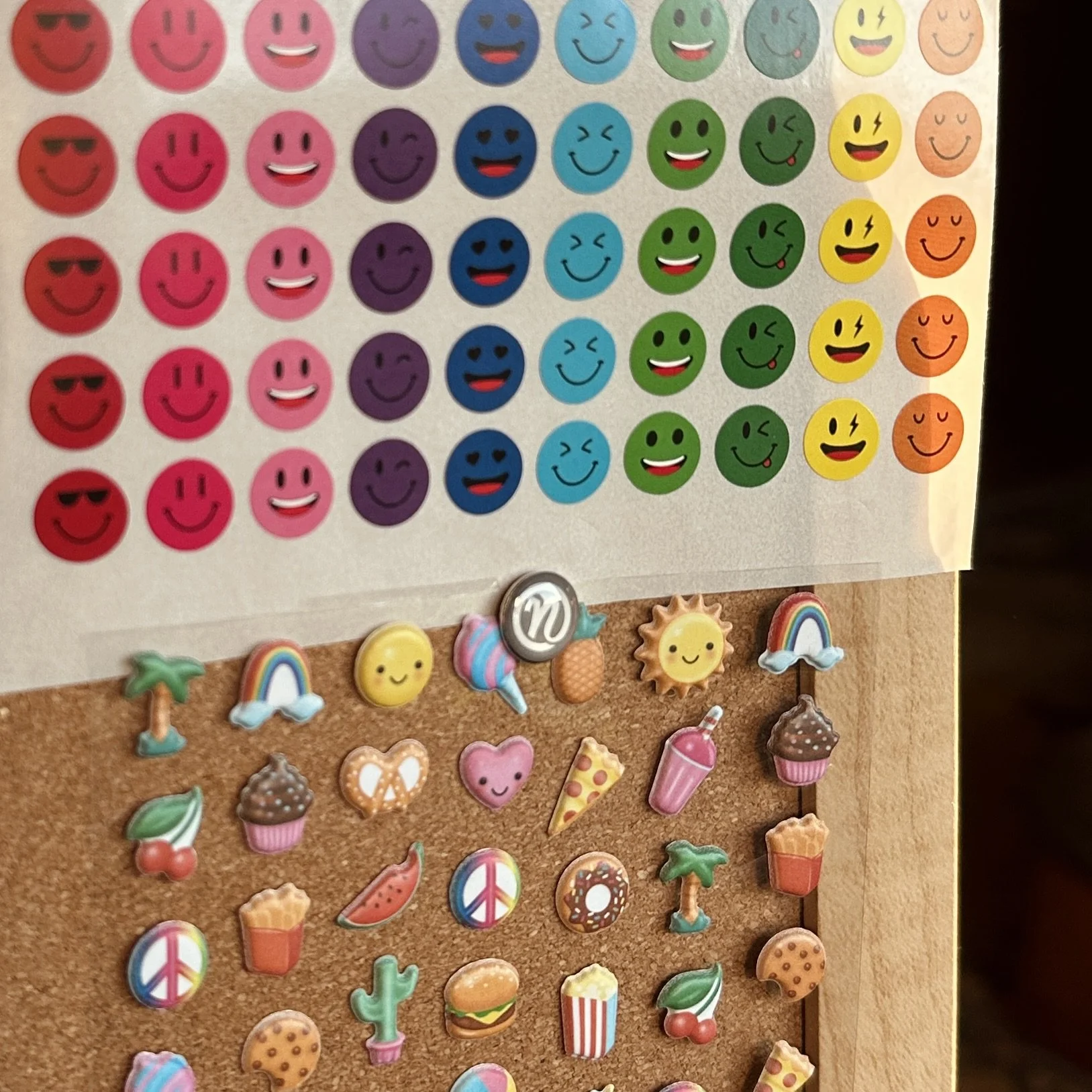
My actual sticker sheets—yes, these. I fully lost it (like, audible squeal level) when a friend gifted me these puffy food stickers because apparently this is what brings me joy now.
Why Consistency Is Hard for Neurodivergent Adults
For most of my life, I’ve had big goals.
Not just “I should probably drink more water” goals. I’m talking layered, ambitious, interconnected visions. Business ideas. Learning plans. Personal growth arcs. Entire internal TED Talks.
And I love that about myself.
But the gap between “big vision” and “daily follow-through”? That’s where things would fall apart.
I would:
get overwhelmed by the sheer number of steps
struggle to break things down into something actionable
lose track of what I was doing mid-process
jump to something new because it felt more interesting or urgent
And then, eventually, I’d tell myself some version of:
“I just need to be more consistent.”
Which sounds reasonable. Until you realize consistency isn’t a personality trait.
It’s a support-dependent skill.
How ADHD and Autism Affect Motivation and Task Follow-Through
When you’re neurodivergent—especially AuDHD—there are a few things working against traditional productivity advice:
1. Your brain doesn’t reliably track tasks internally
Working memory gets overloaded fast. “I’ll remember later” is a lie we’ve all told ourselves.
2. Motivation isn’t linear
Interest, novelty, urgency, and reward all play a role. If something becomes too familiar, your brain stops responding to it.
3. Cognitive load adds up quickly
Planning, prioritizing, sequencing, initiating… that’s a lot of invisible effort.
4. Big goals don’t naturally translate into small steps
Not because you’re incapable—but because your brain doesn’t automatically scaffold that way.
So when we rely on purely internal systems—mental to-do lists, vague intentions, willpower—we’re essentially asking our brain to do high-load processing without support.
And then we’re surprised when it drops the ball.
A Simple Neurodivergent-Friendly Productivity System That Works
So I tried something different.
Actually, two things.
1. The Sticker Sheet (a.k.a. Daily Consistency Support)
I created a visual sheet with a handful of daily anchors:
bedtime
giving my dog their medication
reading
hobbies
movement
Nothing excessive. Just the things that matter.
Every day I complete one, I get a sticker.
And those stickers? They have a monetary value. Which means eventually, I get to exchange them for something fun, unnecessary, or mildly ridiculous.
Is this a tiny, self-imposed reward economy?
Yes.
Do I love it?
Also yes.
There’s something about physically placing a sticker that closes the loop in a way checking a box never did. It’s sensory. It’s visible. It’s a moment of completion.
And—this part matters—it’s not boring.
When I noticed myself getting a little lax recently, it wasn’t because the system stopped working.
It was because it stopped being interesting.
So I changed the stickers.
That was it.
2. The Post-it System (a.k.a. Externalizing My Brain)
For bigger goals, I use a layered post-it system.
Each goal gets a color. Then I break it down:
large post-it = big goal
medium = sub-tasks
small = actionable steps
If something still feels vague or overwhelming, it gets broken down again.
Then, when I’m working:
I take a few small post-its off the board
place them near my desk
complete them
move them into a “done” stack
At the end of the quarter?
I literally have a long, taped-together chain of completed tasks.
Not abstract progress. Not “I think I did stuff.”
Visible. Tangible. Real.
Why Visual and Gamified Systems Improve ADHD Consistency
Here’s why this system has lasted longer than most things I’ve tried:
It externalizes everything
I don’t have to hold tasks in my head.
It reduces decision fatigue
The next step is already broken down.
It provides visual feedback
I can see my progress, not just assume it.
It builds in novelty
I can change colors, stickers, layouts without rebuilding the whole system.
It includes reward in a meaningful way
Not just “good job,” but something my brain actually values.
It incorporates accountability without pressure
My husband checks in. My colleague and I do quarterly reviews. It’s collaborative, not punitive.
Neurodivergent Productivity Isn’t Broken—It’s Misunderstood
I think a lot of us have been taught that if something only works when it’s:
visual
external
gamified
a little bit “extra”
…then it somehow doesn’t count.
Or it means we’re not disciplined enough.
But here’s the thing:
If your brain responds to color, novelty, movement, reward, and visibility…
that’s not a flaw.
That’s information.
And when you build systems that actually use that information instead of fighting it?
Things get easier.
Not effortless. But supported.
A Better Question for Building Neurodivergent-Friendly Systems
The most important shift for me wasn’t the sticker sheet or the post-its.
It was this:
Instead of asking,
“Why can’t I just stick to things?”
I started asking,
“What kind of support would make sticking to things possible for my brain?”
That question changes everything.
Because now you’re not trying to become a different kind of person.
You’re designing a system that actually fits the one you already are.
And if that system includes stickers?
I fully support that.